Quick Answer: Is Questrade TFSA Good?
Yes, a Questrade TFSA can be good if you want to invest in ETFs, stocks, and other eligible investments inside a tax-free account. It’s better for people who want more control. It may not be the best fit if you only want a simple savings account with no investing decisions.
A lot of Canadians hear about Questrade when they start looking for a TFSA. Usually the reason is simple. They want something better than a basic bank TFSA that pays a small amount of interest. Fair enough.
But the real question is not just “Is Questrade good?” The better question is, “Is Questrade TFSA good for the way I want to save or invest?” That answer depends on your comfort level, your goals, and how much control you want over your money.
A TFSA is not only a savings account. It can also be an investment account. That’s where Questrade comes in. You can use it to hold investments like ETFs, stocks, bonds, mutual funds, and other eligible assets. So yes, it can be useful. But it’s not perfect for everyone.
What Is a Questrade TFSA?
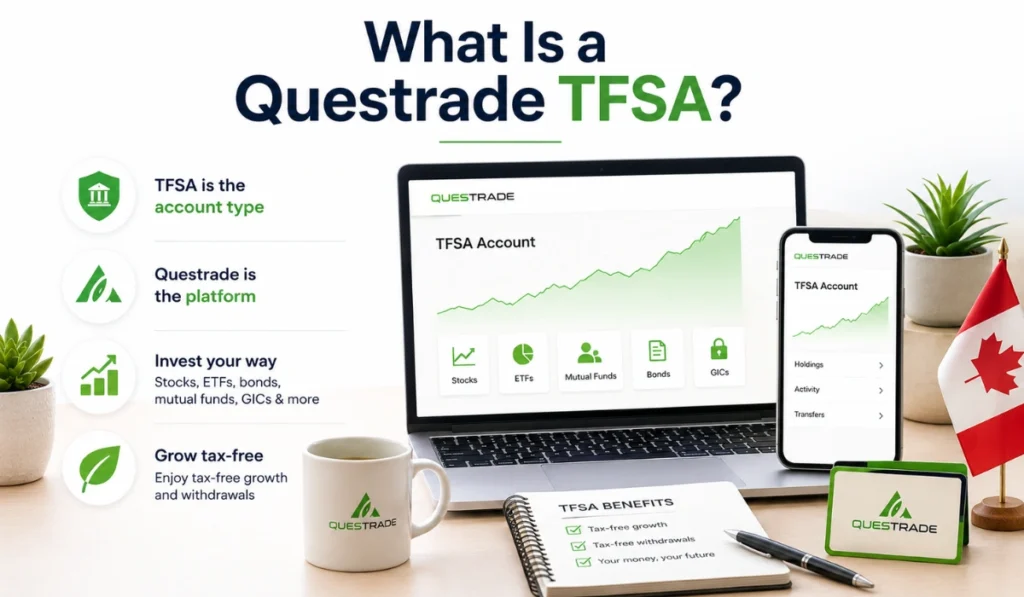
A Questrade TFSA is a Tax-Free Savings Account opened through Questrade, which is an online investing platform in Canada. The TFSA is the account type. Questrade is the place where you open and manage it.
This is important because people often mix these two things. TFSA rules come from the government and CRA. Questrade does not create your contribution room. It only gives you a platform to hold and trade eligible investments in your TFSA.
With a self-directed Questrade TFSA, you choose your own investments. That may include Canadian stocks, U.S. stocks, ETFs, bonds, mutual funds, GICs, and other allowed investments. There is also Questwealth Portfolios, which is Questrade’s managed investing option for people who don’t want to pick everything themselves.
The tax benefit is the main reason people use a TFSA. Money can grow inside the account without tax on eligible gains, and withdrawals are generally tax-free. Still, you must follow TFSA contribution room rules. That part does not disappear just because you use Questrade.
Why Questrade TFSA Can Be Good
Questrade TFSA can be a strong choice for people who want to invest instead of just park cash. If your goal is long-term growth, a self-directed TFSA gives you more options than many regular bank TFSAs.
For example, a bank TFSA may only offer a savings account or GIC. That can be fine for short-term savings. But if you want to build a portfolio with ETFs or stocks, Questrade gives you more control. You can choose broad-market ETFs, dividend stocks, U.S. stocks, or a mix that fits your plan.
Another reason people like Questrade is cost. Questrade now lists online Canadian and U.S. stocks and ETFs as commission-free, though other fees can still apply. That matters because trading costs can eat into smaller TFSA accounts if you’re adding money slowly.
It can also work well for passive investors. Someone who wants to buy one or two broad ETFs each month or each quarter may find Questrade useful. You don’t need to trade every day. In fact, most beginners are probably better off not doing that.
The main thing is this: Questrade is good when you know what you want to hold, or you’re willing to learn slowly. It gives you tools and choices. But choices can also confuse you if you’re brand new.
Questrade TFSA vs Bank TFSA
A bank TFSA and a Questrade TFSA can both be real TFSAs. The difference is what you usually do inside the account.
| Feature | Questrade TFSA | Bank TFSA |
|---|---|---|
| Best for | Investing in ETFs, stocks, and portfolios | Simple savings or GICs |
| Control | More control over investments | Less control, usually simpler |
| Risk level | Can go up or down with markets | Lower risk if held as cash savings |
| Growth potential | Higher over time, but not guaranteed | Usually lower, but more stable |
| Beginner ease | Takes more learning | Easier to understand |
| Good for short-term cash | Not always ideal | Often better |
A bank TFSA may be better if you need the money soon. For example, if you’re saving for rent, school fees, emergency money, or a car in a few months, you may not want market risk. Cash can be boring, but boring is sometimes useful.
Questrade makes more sense when your TFSA is for investing. If you’re thinking in years, not weeks, then ETFs and stocks may make more sense. Of course, investments can lose value too. A TFSA does not protect you from poor investment decisions or market downturns.
Mistakes to Avoid With a Questrade TFSA
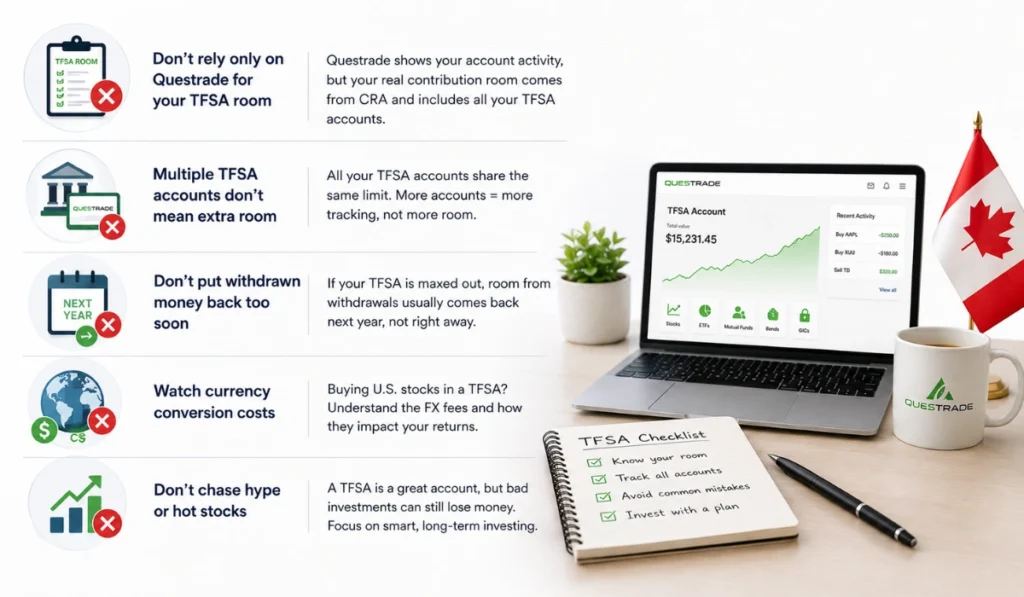
One common mistake is thinking Questrade tracks your TFSA room perfectly for you. It may show your account activity, but your real contribution room is based on CRA rules and your total TFSA activity across all institutions.
So if you have one TFSA at a bank and another one at Questrade, both count toward the same limit. You don’t get an extra room because you have more accounts. This mistake can lead to over-contribution, and CRA can charge a penalty if you contribute too much.
Another mistake is putting withdrawn money back too soon. If your TFSA is maxed out and you withdraw money this year, that room usually comes back next year. Not right away. Many people get caught here because it feels like they’re just replacing their own money.
You also need to watch currency conversion. If you buy U.S. stocks in a TFSA, foreign exchange costs can matter. This does not mean you should avoid U.S. investments, but you should understand what you’re paying.
And then there’s the investing side. Don’t buy something only because someone online said it’s going up. A TFSA is a great account, but it can still hold bad investments. Tax-free growth is only helpful when there is growth.
Who Is Questrade TFSA Best For?
Questrade TFSA is not a one-size-fits-all account. It fits some people very well and others not so much.
| Good Fit | Not the Best Fit |
|---|---|
| You want to buy ETFs or stocks | You only want a simple savings account |
| You’re investing for the long term | You need the money very soon |
| You want more control | You dislike managing investments |
| You’re willing to learn basic investing | You want everything done for you |
| You already understand TFSA room | You’re unsure about contribution limits |
For a beginner who wants to learn ETF investing, Questrade can be a good place to start. You can keep things simple with broad-market ETFs and avoid over-trading. No need to make it fancy.
For someone who wants help managing the money, Questwealth Portfolios may be easier than the self-directed side. It offers a managed portfolio option that can suit people who don’t want to choose every ETF or stock.
But if you just want to earn interest on cash, a regular bank TFSA or high-interest TFSA may feel easier. That’s not a bad choice. It just depends on your goal.
How to Decide If Questrade TFSA Is Right for You
Start with your goal. Are you saving for something soon, or investing for the future? If the money is for a short-term need, market investing may be too risky. If the money is for long-term growth, Questrade becomes more interesting.
Next, check your TFSA contribution room. This is not optional. Before you move or add money, look at your CRA account and your own records. If you’re not sure, you can use the TFSA calculator on our homepage to estimate your available room before making a contribution.
Then think about your comfort level. Are you okay choosing investments yourself? You don’t need to be an expert, but you should know what you’re buying. An ETF, a stock, and a GIC are not the same thing. They behave differently.
After that, look at costs. Questrade may be low-cost for many stock and ETF investors, but other charges can still exist. These may include currency conversion costs, some product fees, managed portfolio fees, or other account-related charges depending on what you do.
Last, ask yourself how hands-on you want to be. If you enjoy learning and checking your portfolio from time to time, self-directed investing may work. If you want a more guided route, a managed option may fit better.
FAQs About Questrade TFSA
It can be good for beginners who are willing to learn basic investing. If you want to buy simple ETFs and invest for the long term, it may work well. But if you feel nervous choosing investments, a managed portfolio or bank TFSA may be easier.
It depends on your goal. Questrade is usually better for investing in ETFs, stocks, and portfolios. A bank TFSA may be better for simple cash savings, short-term goals, or people who do not want market risk.
Yes, you can buy ETFs in a Questrade TFSA. Many investors use TFSAs for ETF investing because the account can allow tax-free growth and tax-free withdrawals under TFSA rules.
Financial institutions report TFSA activity to CRA. Still, you should track your own contributions and withdrawals, as CRA numbers may not always reflect the latest transactions right away.
Yes, you can transfer a TFSA to Questrade. It’s usually better to use a direct transfer rather than withdrawing the money yourself and re-contributing it. That helps avoid contribution room problems.
Yes. A TFSA gives tax benefits, but it does not remove investment risk. If you buy stocks or ETFs and their value drops, your TFSA balance can go down.
Final Thoughts
So, is Questrade TFSA good? For many Canadian investors, yes. It can be a good choice if you want to invest in ETFs, stocks, and other eligible investments inside a TFSA. It gives you more control than a simple bank TFSA, and that can be useful for long-term investing.
But it’s not the best fit for every person. If you only want cash savings, or you don’t want to think about investments at all, a bank TFSA or managed option may feel better. The smart move is to match the account with your goal, not just follow what everyone else is using.
Before you add money, check your TFSA room and make sure you understand what you’re buying. That one step can save you stress later.
Have you used a Questrade TFSA before, or are you still comparing it with a bank TFSA? Share which option you’re leaning toward in the comments.