Quick Answer: The TFSA lifetime limit usually means the total contribution room you’ve earned since you became eligible. In 2026, the annual TFSA limit is $7,000. If you were eligible every year since 2009 and never contributed, your total cumulative TFSA room would be $109,000.
A TFSA sounds simple at first. You put money in, it grows tax-free, and you can take money out when you need it. Nice and easy. But then you hear terms like “TFSA lifetime limit,” “annual limit,” “unused room,” and “cumulative contribution room,” and things start to feel a bit messy.
The main confusion is this: people often think the TFSA has one fixed lifetime cap for everyone. It doesn’t work that way. Your personal TFSA room depends on when you became eligible, how much you already contributed, and whether you made withdrawals in past years.
So, let’s make it plain. This guide explains what the lifetime TFSA limit means, how it’s different from the yearly limit, and how you can check your own available room before adding money.
What Does “Lifetime Limit” Mean for a TFSA?
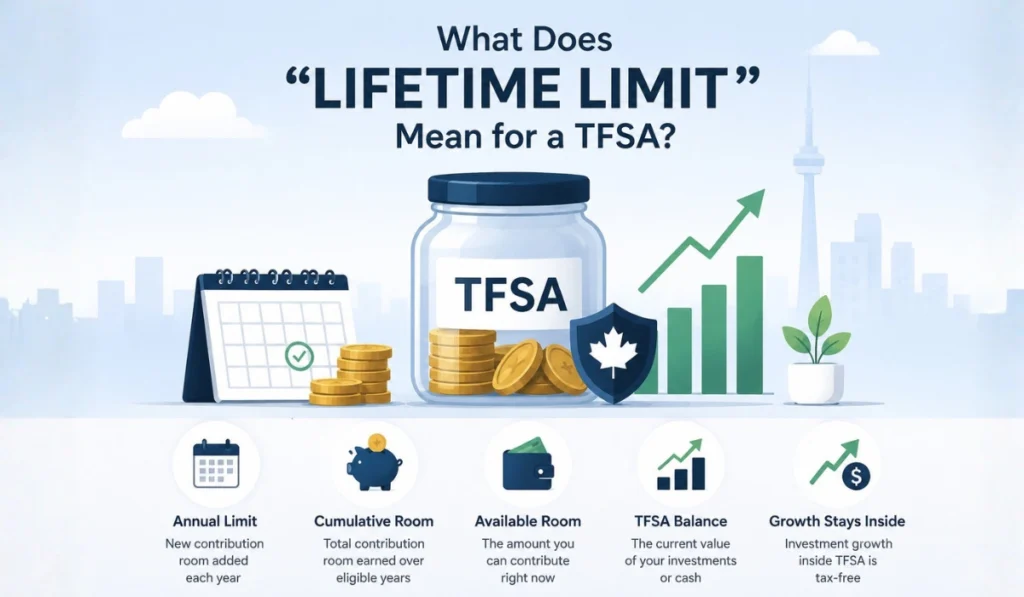
The “lifetime limit for TFSA” is not really an official fixed limit on how much your account can be worth. It usually means the total TFSA contribution room you’ve built up over your eligible years.
For example, if someone was 18 or older in 2009, lived in Canada every year, and never contributed to a TFSA, they would have the full cumulative room by 2026. That amount is $109,000.
But this does not mean every Canadian can put in $109,000 right now. Some people became eligible later. Some have already used part of their room. Some withdrew money in past years. So the real number is personal.
A simple way to think about it is this:
| TFSA Term | What It Means |
|---|---|
| Annual TFSA limit | The new room added for one year |
| Lifetime or cumulative room | The total room earned over all eligible years |
| Available contribution room | The amount you can still contribute now |
| TFSA balance | The current value of your TFSA investments or cash |
This matters because your TFSA balance can grow higher than your contribution room. If your investments grow inside the account, that growth does not count as a new contribution.
Why Your TFSA Lifetime Limit May Be Different
Not everyone has the same TFSA lifetime contribution room. That’s where many mistakes start.
You usually start earning TFSA room when you are 18 or older, have a valid Social Insurance Number, and are a resident of Canada for tax purposes. The TFSA program started in 2009, so nobody earned TFSA room before that year.
If you turned 18 after 2009, your lifetime room starts from the year you became eligible. For example, someone who turned 18 in 2020 would not get room from 2009 to 2019. Their total room would be much lower than someone who was already eligible in 2009.
Your contribution history also changes the number. If your total earned room is $109,000 but you already contributed $40,000 over the years, you do not still have $109,000 available. You used part of it.
Withdrawals can also affect your room, but not always right away. If you withdraw money from your TFSA, that amount is added back to your contribution room on January 1 of the next year. Not the same day. That part catches people off guard.
How to Calculate Your TFSA Contribution Room
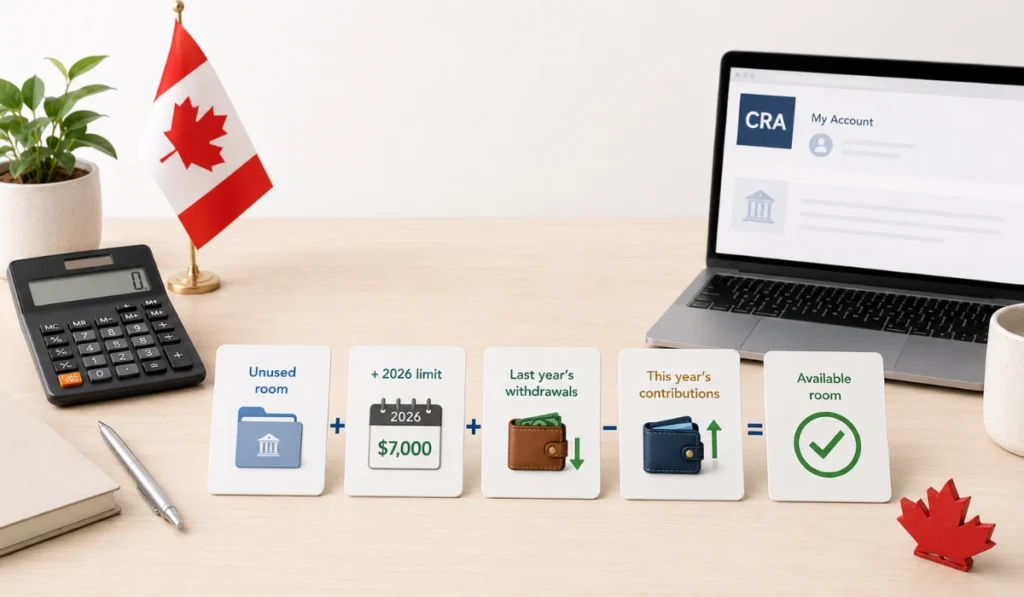
The safest way is to check your own records and compare them with your CRA account. Don’t only guess from a chart online, because your TFSA room depends on your personal activity.
Here’s the simple formula:
Unused TFSA room from previous years + current year limit + withdrawals from last year – current year contributions = available TFSA room
Let’s break that down in normal words.
Start with the unused room you had before this year. Then add the new annual TFSA limit for the current year. For 2026, that yearly limit is $7,000. After that, add withdrawals you made last year, because they come back as room this year. Then subtract anything you already contributed this year.
You can check your TFSA contribution room in CRA My Account, but be careful. CRA numbers may not always show your most recent bank or investment transactions right away. Your financial institution reports TFSA activity to CRA, and there can be delays.
That’s why it’s smart to keep your own list too. Check your TFSA contributions, withdrawals, and transfers.
If you want a faster estimate, you can also use the TFSA calculator on our homepage to get a clearer idea before you contribute.
Common TFSA Lifetime Limit Mistakes to Avoid
The biggest mistake is thinking your TFSA has a maximum balance limit. It doesn’t. The limit applies to how much you contribute, not how much your investments grow. If your $20,000 investment grows to $30,000 inside the TFSA, that extra $10,000 does not use more room.
Another common mistake is re-contributing too early after a withdrawal. Say your TFSA is already maxed out and you withdraw $5,000 in June. You usually need to wait until January 1 of the next year to put that $5,000 back. If you add it back in the same year without having extra room, you may over-contribute.
People also forget that multiple TFSA accounts share the same room. You can have a TFSA at one bank and another TFSA at a brokerage, but your contribution room does not double. CRA looks at your total contributions across all TFSA accounts.
One more thing. Transfers should be done the right way. If you move TFSA money from one bank to another by withdrawing it yourself and then depositing it again, it can create a contribution problem. A direct TFSA transfer between institutions is usually the cleaner way.
Tips Before You Contribute to Your TFSA
Before adding money, check your available TFSA contribution room. It sounds boring, yes, but it can save you from penalties.
Keep a small record of:
- How much have you contributed this year
- How much did you withdraw last year
- Which TFSA accounts do you use
- Any direct transfers between banks or brokers
- Your latest CRA room estimate
This does not need to be complicated. A simple spreadsheet or notes app can work. The main thing is to avoid relying on memory, because TFSA numbers can get confusing after a few years.
Also, don’t rush to max out your TFSA if you’re unsure about your room. It’s better to check first than fix an over-contribution later.
FAQs About TFSA Lifetime Limits
No. There is no fixed lifetime maximum balance for a TFSA. The limit is on contributions, not growth. If your investments grow inside the account, that growth can stay tax-free and does not reduce your contribution room.
For someone eligible every year since 2009 and who never contributed, the cumulative TFSA contribution room in 2026 is $109,000. Your personal available room may be lower or higher depending on contributions, withdrawals, and eligibility.
No. Your room depends on when you became eligible. You normally need to be at least 18, have a valid SIN, and be a Canadian resident for tax purposes.
Withdrawals are added back to your TFSA contribution room, but usually on January 1 of the next year. If you put the money back too soon, you may over-contribute.
Yes, you can have more than one TFSA. But all your accounts share one total contribution room. Having two or three accounts does not give you extra room.
Final Thoughts
The lifetime limit for TFSA is best understood as your total earned contribution room, not a hard cap on your account value. In 2026, the annual TFSA limit is $7,000, and the full cumulative room for someone eligible since 2009 is $109,000.
Your own number may be different, though. That’s the part to remember. Check your CRA account, review your bank records, and use the TFSA calculator on our site before making a new contribution.
Have you ever been confused about your TFSA room after making a withdrawal? Comment below and share what part feels tricky.